
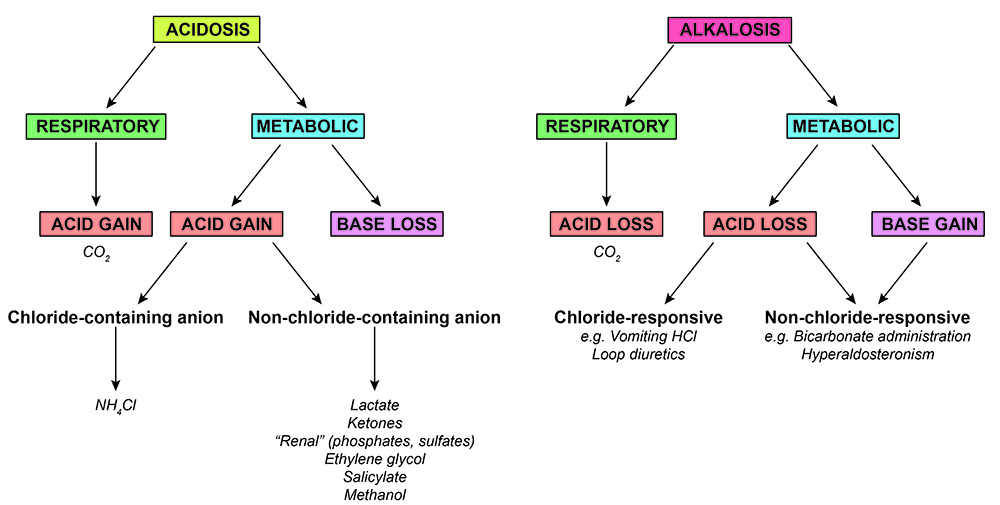
Acid-base disturbances can be separated by type (acidosis, alkalosis) and origin (respiratory, metabolic). in this flow chart, we have broken it down by type and then by origin, providing examples of different causes. Acidosis is due to accumulation of a respiratory acid (carbon dioxide) or metabolic acid, which can contain chloride as an anion with the hydrogen, resulting in a normal anion gap or strong ion (hyperchloremic) metabolic acidosis, or a non-chloride-containing anion for the hydrogen (e.g. lactate) resulting in a high anion gap metabolic acidosis. A normal anion gap or strong ion metabolic acidosis can also be caused by loss of a base (bicarbonate or sodium in excess of chloride). An alkalosis is caused by the converse situations; respiratory alkalosis is due to a loss of carbon dioxide in the lungs with hyperventilation) whereas metabolic alkalosis is due to loss of a chloride-containing acid or gain of a base.